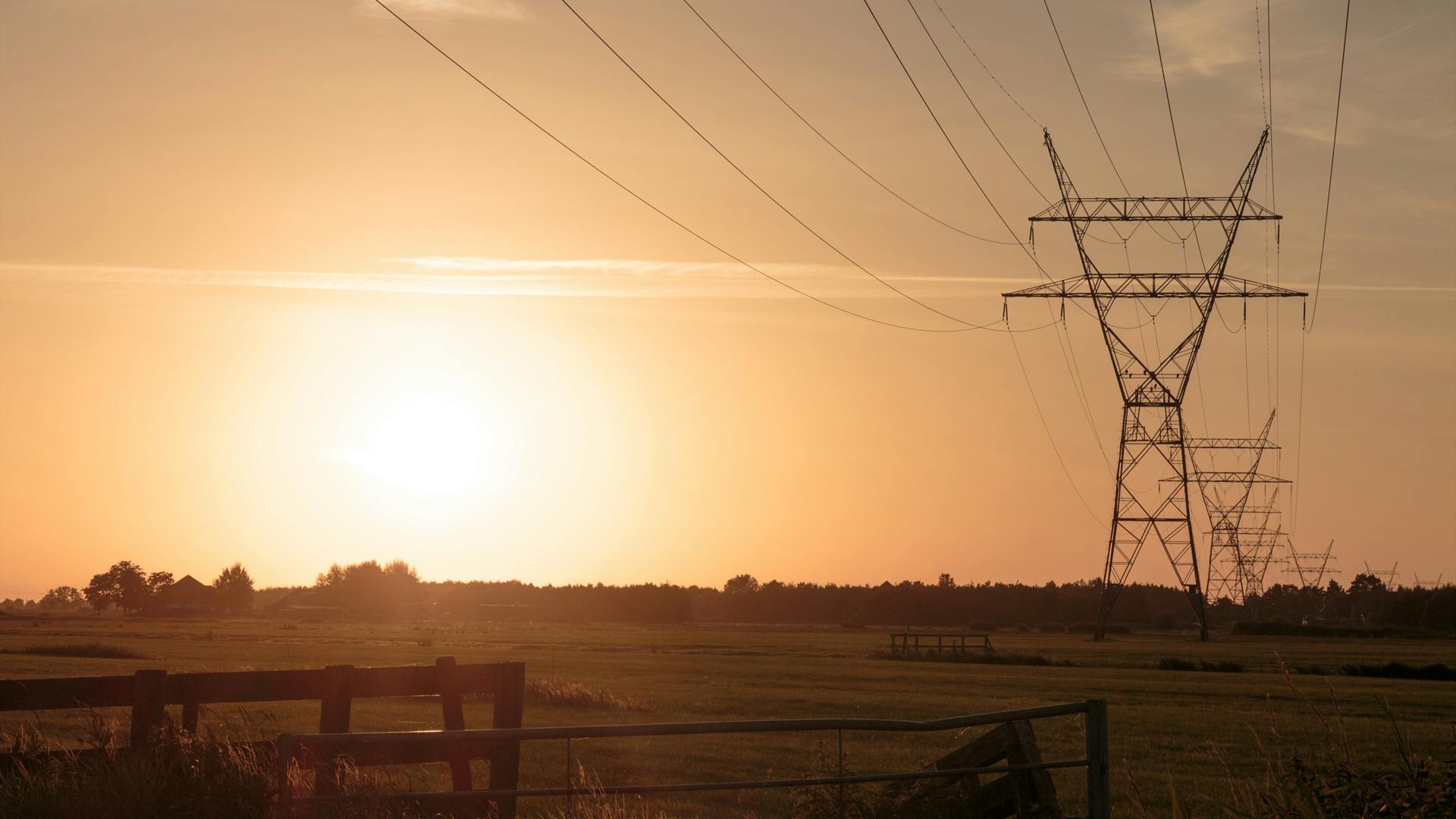
What is grid congestion?
The grid is congested when it cannot carry any more power at busy moments. Dutch grid operators' association Netbeheer Nederland distinguishes congestion for feed-in (power onto the grid, for example from a wind turbine or solar park) and for offtake (power from the grid). In many places there is no room left in one or both directions.
The capacity map of Netbeheer Nederland shows the status per area, for offtake and feed-in separately. There are four statuses: transport capacity available without a queue, limited capacity without a queue, area under investigation with a queue, and shortage of transport capacity with a queue.
For new projects this often means a wait of several years. For existing projects it can mean that the grid operator asks them to feed in less at busy moments, either for a fee or as a condition of the connection.
How big is the problem?
According to Netbeheer Nederland (Stand van de Uitvoering 2025, April 2026), at the end of 2025 the regional grid operators had about 15,000 offtake requests on the waiting list, together 9,305 MW. For feed-in there were about 8,700 requests, together 5,027 MW. At TenneT, the national grid operator, there were 210 offtake and 168 feed-in requests.
The number of offtake requests at the regional operators kept growing: from about 12,000 a year earlier to 15,000. Netbeheer Nederland writes that flexible use of the grid is lagging behind what is needed to really shorten waiting times.
How does the waiting list work?
Anyone who requests a new connection, a heavier connection or more contracted capacity first receives a quote. If there is no room in your area, the request goes on the waiting list once you sign that quote.
The waiting list applies per congestion area, not nationally. The basic rule is first come, first served. Parties with priority rank higher but must ask for it themselves. When space becomes available, the grid operators allocate it under the ACM's prioritisation framework. How long it takes depends on grid reinforcement in your area. In full areas it can take up to 10 years, according to Netbeheer Nederland.
Why an existing connection is so valuable
An existing connection is something newcomers can no longer get. At a wind turbine or solar park, the connection is used at full capacity only part of the time: at night or when there is no wind it is barely used. Our own solar park in Dalfsen used just 9% of the capacity of its 6 MW connection in 2024.
A battery on the same connection can use that spare capacity. It charges when there is a surplus or when power is cheap, and discharges when there is demand. The connection stays within the contracted capacity you already have.
If you give up a connection, you lose that space. A new request in a congested area goes on the waiting list.
How does a grid operator connect a battery?
This differs per grid operator. Enexis, for example, connects batteries above 1 MW only in a congestion-neutral way. For that you sign a capacity control contract (CSC) in addition to the connection and transport agreement. Enexis can then impose a limit the day before the grid is expected to become full, and the battery must be remotely controllable.
If your connection already has enough transport capacity, Enexis says you do not need a new control contract, but in most cases you do have to report the battery. If that capacity is missing, a request for a heavier connection goes on the waiting list.
The ACM has also introduced new transport rights for users with flexible grid use. The time-duration transport right on TenneT's high-voltage grid guarantees transport for at least 85% of the hours in a year, at a lower grid tariff. The time-block right works on the regional grids, within agreed time blocks. The ACM names battery storage explicitly as an example of a flexible grid user. At the end of 2025 there were 162 contracts for such alternative transport rights.
When does a battery help?
A battery is not the answer for every project. It works well when several things come together:
- There is an existing or committed connection with unused capacity.
- The grid operator allows the combined use, possibly with arrangements for peak moments. In a congested area, sharing a connection may not increase the existing transport capacity.
- There is a revenue model that suits the site: trading on the day-ahead and imbalance markets, ancillary services such as aFRR, or absorbing the site's own peaks.
- The permit and spatial fit are achievable. A battery usually needs an environmental permit (omgevingsvergunning).
What a battery does not solve
A battery on an existing connection does not make the grid bigger. If you want more capacity than your contract allows, you still have to wait until the grid is reinforced. A new, separate connection for a battery alone also joins the same waiting list as everyone else in a full region.
Netbeheer Nederland also stresses that alternative transport rights are not meant to cut the peaks but to fill the valleys. The gain lies in using the moments when there is room. A battery on a connection that already has spare capacity fits that.
How we assess it
Our platform Powerplaats shows, per supply area, the room for feed-in and offtake, and how it has changed since the previous capacity map. It also shows which solar, wind and battery permits have been granted or applied for nearby.
With that, we model a battery for the site: how much power and storage fit, how the battery is dispatched, and what the grid limits mean. Our models are checked against metered data from batteries in operation.